Gene Expression and Biological Regulation
Discover how gene expression is controlled by transcription factors, chromatin, enhancers, RNA processing and cellular signals, and how scientists study regulatory mechanisms.
Gene Expression & Biological Regulation
Every cell contains genetic information. Yet a neuron, an immune cell and a muscle cell use that information differently. How does the same genome support so many biological identities? The answer lies in the sophisticated regulation of gene expression.
Gene expression is not an automatic outcome of carrying a gene. It is a regulated biological process in which DNA accessibility, transcription factors, RNA processing, molecular signaling and protein regulation collectively determine which gene products are made, when they appear and how they influence living cells.
One Genome, Many Cellular Identities
Most nucleated cells in a human organism contain broadly the same nuclear genome. Nevertheless, different cell types perform dramatically different functions. Neurons transmit electrical and chemical signals, hepatocytes carry out numerous metabolic processes, and immune cells detect and respond to biological threats. These differences are not explained primarily by each cell possessing an entirely different set of genes.
Instead, cell identity depends partly on which genes are expressed, how strongly they are expressed and how their products are regulated. Gene expression begins with transcription, in which RNA is synthesized from a DNA template. For protein-coding genes, suitable RNA transcripts may be translated into proteins, but many RNA molecules have functions that do not involve protein synthesis.
A gene may be highly active in one cell type, minimally expressed in another, or activated temporarily in response to an environmental signal. Different regulatory programs therefore allow cells to interpret shared genetic information in different ways. This is fundamental to development, cellular specialization and physiological adaptation.
To understand these differences, researchers first investigate how the transcriptional machinery identifies and uses particular regions of DNA. That leads us to promoters, transcription factors and the molecular initiation of gene expression.
From DNA Sequence to Transcription
In eukaryotic cells, transcription of protein-coding genes is principally carried out by RNA polymerase II. Transcription begins when regulatory proteins and the transcription machinery assemble at or near a gene promoter. Promoters contain sequence features that contribute to transcription initiation, but their activity also depends on surrounding chromatin and regulatory factors.
Sequence-specific transcription factors recognize DNA motifs and participate in activating or repressing transcription. They can recruit cofactors, influence chromatin structure and affect the initiation or elongation of RNA synthesis.
Transcription is regulated at multiple stages. RNA polymerase II may be recruited to a promoter but remain temporarily paused near the transcription start site. Regulatory signals and protein complexes can influence whether the polymerase proceeds into productive elongation.
This helps explain why transcription cannot be reduced to a simple on-or-off switch. Genes may have different transcription initiation rates, exhibit bursts of activity and respond with different timing to changes in cellular conditions.
Transcription factors
Recognize regulatory DNA sequences and participate in molecular complexes that influence gene transcription.
RNA polymerase II
Synthesizes many eukaryotic RNA transcripts, with recruitment, initiation and elongation subject to regulation.
However, transcription factors must interact with DNA that is packaged into chromatin. Understanding that packaging reveals another major layer of biological regulation.
How Chromatin Influences Access to DNA
Eukaryotic DNA is associated with histone proteins to form chromatin. The fundamental chromatin unit, the nucleosome, consists of DNA wrapped around a histone core. Chromatin organizes long DNA molecules within the nucleus, but it also influences the accessibility of regulatory sequences to molecular machinery.
Some genomic regions are relatively accessible to transcription factors and regulatory enzymes, while others are less accessible. This is not a permanently fixed division. ATP-dependent chromatin remodelers, histone modifications and the binding of regulatory proteins can alter the local chromatin environment over time.
DNA methylation and histone modifications can be associated with particular regulatory states. For example, H3K27ac is frequently associated with active enhancers, while H3K4me3 often marks active promoter regions. These are context-dependent associations, not universal rules that independently establish transcriptional activity.
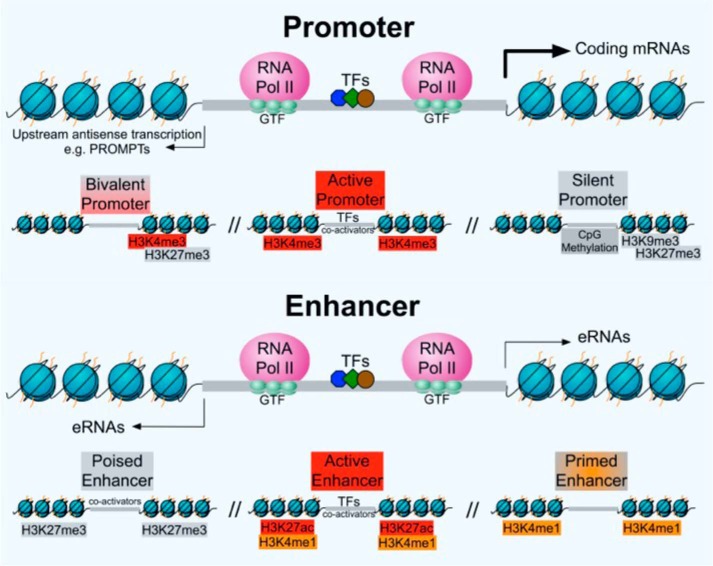
Chromatin accessibility is a useful indicator of regulatory potential, but accessible DNA is not necessarily actively transcribed. Similarly, a particular histone modification cannot, on its own, establish that a regulatory element causes expression of a specific nearby gene.
DNA and Chromatin Regulation
A visual introduction to chromatin, histone modifications and DNA methylation as mechanisms contributing to gene regulation.
Chromatin regulation also operates at larger scales. Genomic sequences that are far apart along the DNA molecule may become spatially proximate within the nucleus. This organization introduces the regulatory roles of enhancers and three-dimensional genome structure.
Enhancers, Promoters and Three-Dimensional Regulation
Enhancers are regulatory DNA elements that can influence transcription of target genes, sometimes from considerable genomic distances. They contain binding sites for transcription factors and can recruit coactivators and chromatin-regulating proteins. Enhancer activity depends strongly on cellular context.
The three-dimensional folding of chromosomes contributes to interactions between enhancers and promoters. Regulatory protein complexes including Mediator and cohesin can participate in the organization of enhancer–promoter contacts, although the molecular mechanisms vary between genomic loci. Physical proximity is not always sufficient to establish functional activation.
Enhancers help explain how cells respond to developmental and environmental signals. A regulatory element may be active in a particular cell lineage or become activated after a signal changes the availability or activity of transcription factors. Multiple regulatory elements can act together to shape gene expression.
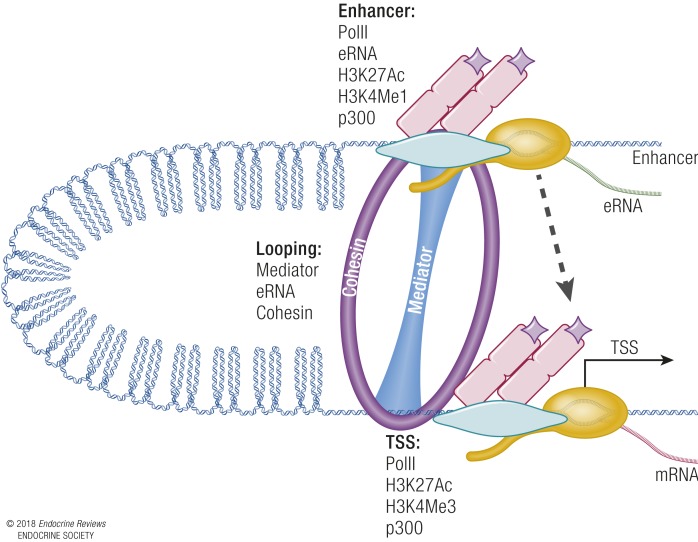
Modern approaches such as chromosome conformation capture can investigate physical proximity among genomic regions, while reporter assays and CRISPR-based perturbations can test the functional effects of candidate enhancers. Combining structural and functional evidence is important because a detected DNA contact does not necessarily prove a regulatory relationship.
RNA Processing and Transcript Diversity
After transcription, many eukaryotic RNA molecules undergo processing before contributing to cellular function. Protein-coding pre-mRNA commonly receives a 5′ cap, has introns removed through splicing, and undergoes 3′ end processing and polyadenylation.
Alternative splicing allows different combinations of exons to be included within mature transcripts. This can produce distinct RNA isoforms from one genomic locus, sometimes giving rise to proteins with different structures or regulatory properties.
RNA processing also influences transcript stability, transport and translation. Regulatory proteins and noncoding RNAs can determine how long transcripts persist and whether they are available to the translation machinery.
Consequently, transcript abundance is the result of both RNA production and RNA removal. A high level of measured RNA does not necessarily indicate a high transcription initiation rate, and two transcripts from the same gene may behave differently under the same cellular condition.
These additional layers matter when interpreting RNA-sequencing experiments. Gene-level analysis may suggest that total transcript abundance remains constant, even when the relative abundance of biologically important isoforms has changed.
From RNA Abundance to Functional Protein
For protein-coding genes, translation converts messenger RNA into polypeptides. Ribosomes read mRNA codons, while transfer RNAs participate in delivering the corresponding amino acids. Yet the quantity of a transcript does not automatically determine the quantity or activity of its protein product.
Protein abundance depends on translation efficiency and protein degradation, among other factors. Protein function can also be regulated through post-translational modifications, folding, molecular interactions and cellular localization.
Consider a signaling pathway that activates a transcription factor. Increased transcription may be detectable by RNA-seq or RT-qPCR, but the downstream biological response may also depend on phosphorylation or localization of an existing protein. These changes may occur without large changes in total protein abundance.
This is why researchers often combine RNA measurements with proteomics, immunoblotting, microscopy and functional experiments. Gene expression is one component of a broader regulatory system that connects genomic information to phenotype.
Gene Expression and Regulation
An illustrated explanation of transcriptional, post-transcriptional, translational and post-translational levels of gene regulation.
How Scientists Measure Gene Expression
Investigating gene expression requires a measurement strategy suited to the biological question. RT-qPCR measures selected RNA-derived targets through reverse transcription and quantitative amplification. It is valuable for focused comparison of specific transcripts when the assay is appropriately validated.
RNA sequencing provides a broader view of transcript-derived sequences and abundance. It can support differential expression analysis, transcript discovery and investigations of alternative splicing, depending on sequencing design and data quality.
To investigate transcriptional regulation more directly, researchers may use methods such as ChIP-seq or CUT&RUN to examine chromatin-associated proteins, ATAC-seq to investigate accessible chromatin, and reporter assays to test the regulatory capacity of candidate DNA sequences. These methods measure different biological properties.
For example, ATAC-seq identifies regions accessible to a transposase under the conditions of the assay, but does not prove that those regions function as enhancers. An RNA-seq expression change does not prove which transcription factor caused the response. Targeted perturbations provide additional mechanistic evidence.
| Method | What it measures | Scientific limitation |
|---|---|---|
| RT-qPCR | Selected RNA-derived targets | Requires careful normalization and controls |
| RNA-seq | Transcript-derived sequencing data | Depends on sampling, library preparation and analysis |
| ATAC-seq | Chromatin accessibility | Accessibility does not independently demonstrate enhancer function |
| ChIP-seq / CUT&RUN | Genomic association of selected proteins or histone marks | Binding or enrichment does not necessarily establish causal regulation |
| Reporter assay | Activity of candidate regulatory sequences in an assay | May not reproduce their native genomic context |
| CRISPR perturbation | Consequences of targeted regulatory changes | Requires appropriate specificity and functional controls |
Thus, measuring transcription, chromatin and regulatory activity requires several complementary approaches. A convincing mechanistic explanation emerges when independent measurements and well-controlled perturbations support the same hypothesis.
RNA-seq, ATAC-seq and Single-Cell Regulatory Landscapes
Modern sequencing technologies can measure thousands of molecular features across large collections of biological samples. Bulk RNA-seq provides transcript information averaged across cells within a sample. Single-cell RNA-seq reveals differences among individually captured cells, allowing researchers to investigate heterogeneous populations and cellular states.
Single-cell ATAC-seq extends this perspective to chromatin accessibility. Combining transcriptomic and accessibility measurements may help identify candidate regulatory programs associated with particular cell populations, especially when multiple molecular modalities are measured in matched cells.
Raw sequencing data require quality assessment, processing, alignment or quantification, normalization and statistical analysis. Single-cell data add challenges including sparse measurements, technical variation, doublets, batch effects and the difficulty of distinguishing continuous cell states from discrete cell types.

Integrative computational analysis can identify statistical associations between accessible regions, transcription factor motifs and gene expression. However, these results are often candidate relationships rather than confirmed causal regulatory mechanisms.
The central challenge in modern regulatory genomics is to move beyond describing large molecular datasets toward understanding how particular regulatory elements and interactions produce a biological outcome.
How Gene Regulation Shapes Cellular States
Imagine a research team examining a population of stem cells as they differentiate into specialized cell types. Although these cells share the same inherited genome, their gene expression programs change as differentiation proceeds. Understanding those changes requires connecting regulatory mechanisms with measurable cellular outcomes.
The researchers might first collect RNA-seq data across different stages of the experiment to identify transcripts that increase or decrease in abundance. They may then investigate chromatin accessibility to determine which genomic regions become more or less accessible as cell states change. Motif analysis can generate hypotheses about the transcription factors associated with these regions.
Observation: A group of transcripts increases during differentiation.
Regulatory hypothesis: A cell-state-associated transcription factor influences enhancers near some of the corresponding genes.
Additional evidence: Chromatin profiling reveals candidate accessible regulatory elements; functional perturbation tests whether they contribute to the observed expression changes.
Biological interpretation: Concordant results may support a proposed mechanism connecting regulatory DNA, transcription and cellular specialization.
Such an experimental progression illustrates why correlation is only the beginning of biological interpretation. A transcription factor motif within accessible chromatin does not establish that the transcription factor is bound or functionally active at that site. A nearby gene may not be its true target.
Targeted regulatory perturbations, independent measurements and replication across biological samples help move the research from descriptive association to experimentally supported mechanism.
Regulatory Genomics and the Future of Biotechnology
Understanding gene regulation has important implications for biotechnology and biomedical research. Regulatory information can help scientists investigate how cell identities are maintained, why biological responses differ, and how changes in noncoding genomic regions influence molecular function.
In functional genomics, CRISPR-based perturbation approaches allow researchers to test candidate genes and regulatory elements. In cellular engineering, knowledge of regulatory mechanisms can help guide the design and assessment of expression systems and engineered cellular functions.
In biopharmaceutical research, understanding transcriptional networks and cell-state transitions supports investigation of molecular targets and experimental disease models. Single-cell and spatial technologies further enable researchers to explore how regulatory programs vary among neighboring cells and different tissue environments.
The field continues to face important limitations. Genome architecture is dynamic, regulatory effects depend on cell type and experimental conditions, and computational predictions may not reliably establish mechanistic relationships without targeted validation.
Ultimately, the scientific story begins with the fundamental organization of DNA and ends with a much broader understanding of living systems. Gene expression emerges from interactions involving regulatory sequences, chromatin, RNA processing, molecular signaling and protein activity.
By connecting high-throughput measurements with mechanistic experiments, scientists can better explain how cellular identity develops, how organisms respond to change and how biological knowledge can support new research tools and biotechnology.
Scientific References
1. Alberts et al. Molecular Biology of the Cell: How Cells Read the Genome. NCBI Bookshelf ↗
2. Lewis, Li & Franco (2019). Transcriptional control by enhancers and enhancer RNAs. Transcription. Peer-reviewed publication ↗
3. Enhancers and chromatin structures (2017). Regulatory hubs in gene expression and diseases. Read on PMC ↗
4. Chromatin accessibility: methods, mechanisms and biological insights (2022). Read on PMC ↗
5. The chromatin signatures of enhancers and their dynamic regulation (2022). Read on PMC ↗
6. Enhancer RNAs in transcriptional regulation: recent insights (2023). Frontiers in Cell and Developmental Biology. Read the review ↗